
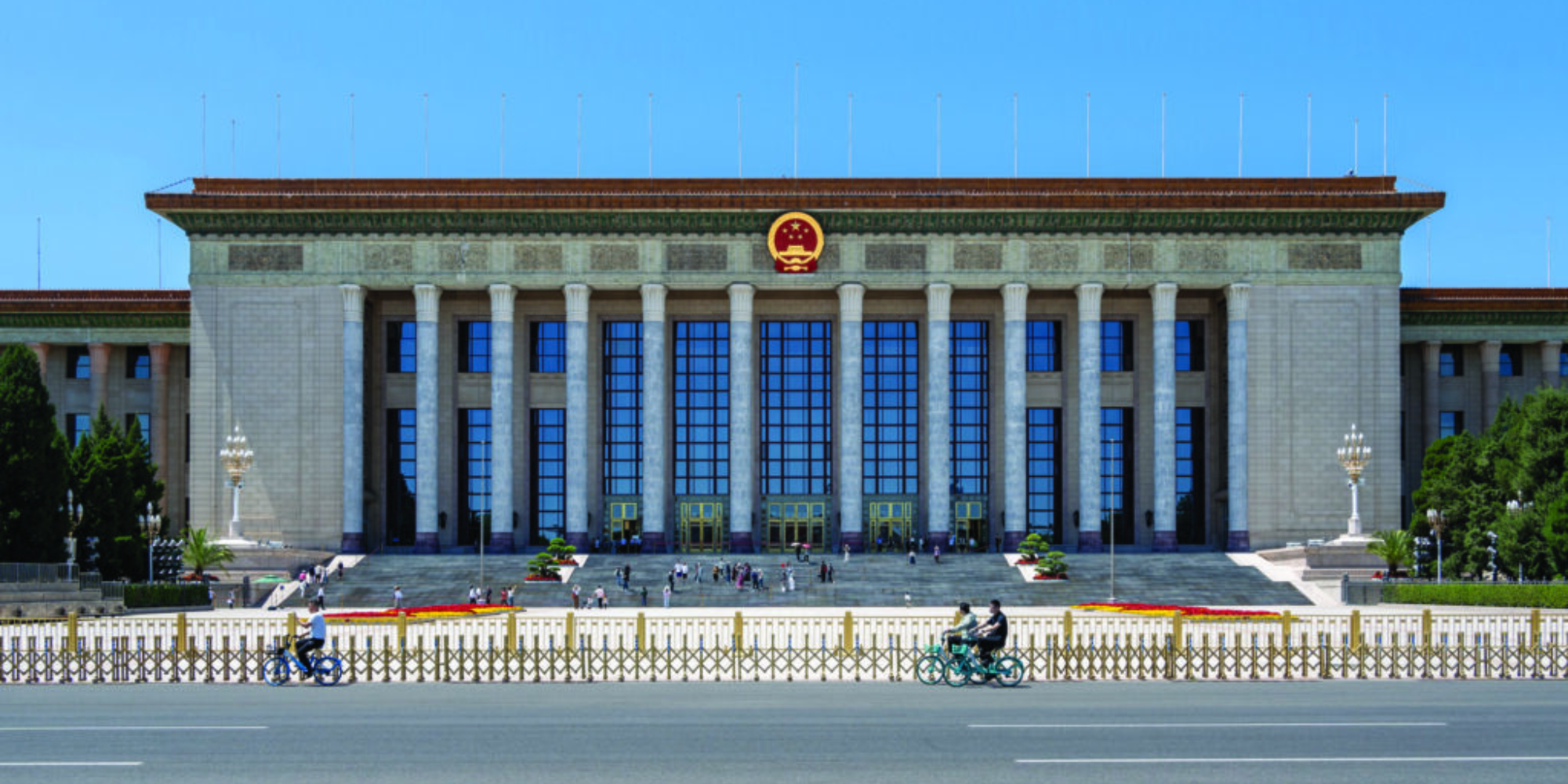
Pillars of Power | The Great Hall of the People in Beijing, the principal venue of China’s National People’s Congress | Image Courtesy: xiquinhosilva (CC BY 2.0)
When asked in 1924 why he wanted to climb Mount Everest, the British mountaineer George Mallory is reported to have replied, “Because it’s there.” He would disappear on Everest later that same year during an attempt to reach the summit. Many of India’s attempts to study and understand China evoke aspects of both the Mallory story and his final reality.
It is obvious that India needs to study and understand China simply “because it’s there” – an overhanging military threat to India’s northern borders, a coercive economic power seeking to limit Indian economic growth and competitiveness, a competing political model and development partner in India’s neighbourhood and beyond, and a civilizational power with a conceit matching or exceeding India’s own. And yet, the study and analysis of China in India leaves much to be desired.
Constraints
There is a lack of capacity on China in Indian universities, government, military and industry – knowledge remains limited in volume for the scale of the challenge that China presents, and its production is ad hoc and episodic. The building of capacity must always be supported by the government in the initial stages, but while knowledge is now increasingly produced within India, there remain multiple problems with the government’s approach to this knowledge and its Indian producers, be they a university academic, think-tanker, military officer or diplomat.
First, there is a tendency to privilege knowledge produced in-house or within the four walls of government – the “experience” of someone within government or in uniform is somehow seen as being more valuable and better than that of practitioners from other fields – scholars or businessmen, for example – even when it is the latter’s domains of expertise that are being discussed.
Following from this, a second tendency arises quite naturally – the desire to ignore expertise or inconvenient points of view altogether. A related phenomenon is the business of pulling rank or banking on seniority – particularly within the military and the civilian bureaucracy – to settle or decide the answer. Almost 70 years ago, Mao Zedong’s call for students and intellectuals to be both “red and expert,” that is to combine ideological commitment and political loyalty with technical expertise preceded the disastrous Great Leap Forward. It is a problem that has not entirely disappeared in China if the travails of its economy are considered. Given India’s many crises – and the challenge that China poses across multiple domains, is surely a crisis – its policymakers cannot afford to be comfortably numb.
Third, if after crossing the above hurdles, there is investment at all in capacities outside the government sphere, the record suggests that it has been something of a poisoned chalice. Funding support is often too little, investment horizons are too short, and practically no useful information is shared, even as the demands are many. Under this kind of pressure, Indian think-tanks and research institutions devoted to China or with China programmes that have depended exclusively on government support for any length of time have inevitably declined.
Green Shoots of Change
Bias, hierarchy and the lack of strategic foresight and planning are not issues that are about to disappear overnight. China Studies in India is at least a couple of decades behind international peers in terms of ambition and range of work, and not yet aligned to studying questions of most immediate importance or relevance for India – whether it is government, economy, industry or society. Since 2013, however, when it could be argued that China’s assertiveness along the Line of Actual Control with India began undergoing a qualitative change, and particularly after the Galwan incident in 2020, parts of the Indian government, academia and industry have begun changing their approaches.
In sections of the government, there is now certainly greater humility and receptiveness to outside inputs as well as recognition that domestic capacity needs greater encouragement and support. In addition to government agencies, both private industry and private universities have begun to pay greater attention to China and to fund increasingly more complex studies. The floodgates have not yet opened, but a beginning has been made, and it looks likely to be sustained.
Meanwhile, Indian scholars and analysts are also increasingly better-trained in both language – thanks largely to extensive and well-funded scholarships and fellowships from China and Taiwan – and social science skills. They are also in increasing demand globally for the quality of their work and their perspectives – certainly, the West has realised that Indian insights on China simply cannot be ignored. However weak the Indian military response might have been in the wake of Galwan, the fact that there was a response at all has perhaps indirectly facilitated greater global attention to China scholarship and analysis from India. It is another sign, if one were needed, that India benefits from a whole-of-the-system approach to tackling its foreign policy challenges.
Overall, then – and this special issue is an example – there are reasons for cautious optimism about the future of China studies in India, and to believe that it is possible for Indian scholars and analysts to be leaders in the field.
Four Themes
This special issue seeks to identify certain key areas in which China has built up capacities, how India reads and can misread their import and how it must respond. It does not purport to be a comprehensive list of the challenges that China poses to India, of its strengths or of India’s shortcomings – but in the diversity of themes addressed, the idea is to convey a sense of the scale of the challenges before India and to encourage faster and greater all-round reform of China studies and analysis in the country.
The first theme addresses questions of strategy and politics. And we start with who else but Sun Tzu – still, the most (and often, the only) recognised Chinese strategic thinker in Indian institutions. In the first essay, Kajari Kamal clinically takes apart the Indian obsession with comparing Sun Tzu and Kautilya. She highlights the deficiencies in the scope and quality of the comparison, noting how the study of Kautilya itself in Indian institutions has been affected as a result. From ancient thinkers, Devendra Kumar brings us sharply up to present-day strategy, asking if there is such a thing as the “Tibet card” in India’s hand. He notes how the Chinese have constantly evolved their strategies in the Tibetan areas while India continues to be diffident about stating clearly its interests vis-à-vis Tibet and claiming its own historical and cultural legacies in Tibetan and other ethnic minority regions now controlled by China.
India’s ongoing military challenge from China has undergirded much of New Delhi’s policy choices across multiple sectors in the past few years. It forms the second major theme of this special issue, but the two essays here differ from standard approaches to the problem by shifting scale and perspective. The essay by TSV Ramana is a forensic examination of the problems of analysis and assessment of China within the Indian military. His solutions are widely applicable across any sector that studies China professionally. Anshuman Narang offers a careful and thorough examination of how the Western Theatre Command of the Chinese People’s Liberation Army (PLA) – the largest of China’s five theatre commands and the one that faces India – has been building up asymmetric advantages against India. His examination moves beyond the PLA to highlight potentially dual-use capabilities in the transport and energy sectors that China has built up over time.
The third theme covers the burgeoning Chinese economic challenge to India across a number of sectors. While there is a great deal of talk of Indian capabilities, the Chinese have several lessons to offer in the conversion of capabilities into capacities. Aravind Yelery begins by identifying a fundamental problem at the heart of the failure of this conversion in India – the structural weaknesses of its universities and research organisations. Lacking in resources and basic infrastructure and mired in subservience to hierarchy and a preference for bureaucratic processes over concrete results, Indian higher education institutions remain the weakest link in India’s growth story. The contrast in policy approaches and spending figures for India and China that he serves up should be the stuff of questions in the Indian Parliament.
Venkat Raman extends the argument noting the entrepreneurship of China’s universities in supporting its innovation ecosystem. He criticises both dated Indian views on how the Chinese have managed to achieve their technological prowess as well as that holy grail of Indian entrepreneurship, namely, the culture of jugaad. He notes the Chinese Party-state’s willingness to absorb risks and its promotion of academia-industry engagement and the fusion of civilian and military goals as reasons for China’s leadership in key technologies today. Shruti Kalyani offers us a deep dive into a facet often ignored in Indian studies of China’s technological advancement, namely its ambitious plans to transition to a hydrogen economy. She highlights how China has been fixing both demand- and supply-side issues to speed up the transition, offering clear lessons for India in the pursuit of its own similar ambitions.
Anand Krishnan’s essay examines how the combination of Chinese political norms and business practices have combined to exclude Indians from higher management positions in Chinese companies operating in India. That Chinese entities can ignore the Indian government’s pressure on the issue despite tensions in bilateral relations points to larger structural problems in India of administrative incapacity and weak governance. The essay by Priyanka Pandit scales up matters by examining the impact China has on global economic governance. She observes that China retains an interest in the smooth functioning of the Bretton Woods twins being both a beneficiary and an influencer. Crucially, she also points out that despite its rhetoric and its creation of new institutions focused on the developing world, China appears, in practice, to be stepping back from concrete commitments and support for Global South interests in multilateral forums. This is a space she notes that India can fill if only it would reform its own trade policies and manufacturing sector.
The final theme of this special issue highlights China’s weaponisation of cultural capital – both its own and those of other countries – in the pursuit of its political and foreign policy interests. While traditional sources such as speeches of Chinese leaders and editorials of the Communist Party’s official mouthpiece, the People’s Daily, remain important for understanding China’s self-conception and geopolitical priorities, unconventional sources such as its literature, movies and social media offer alternative readings and sources of China’s ambitions. Cherry Hitkari examines cartoons in China’s official press targeted at foreigners to highlight what they say about the Party-state’s views of India. While these views cover a wide range – from India as a “shackled” civilisation to being a tool of the West – the overwhelming picture painted seems to be one of India lacking agency, a convenient trope that also serves to emphasise China’s own perceived advantages over India. Shanky Chandra’s exposition on Chinese science fiction is as cutting-edge and refined as the genre itself is. The oeuvre of Chinese sci-fi is remarkable for something that emanates from an authoritarian state, covering not just futuristic technology and future war but also political systems and anomie. Given its global success, the Chinese Party-state has, of course, begun to intervene and shape these narratives. Even so, the contrast with India is sharp – Indian sci-fi is yet to take wings – and there is no power that has become a great one without also producing great sci-fi.
The final essay by Pavan Raghavendra should surprise many Indians with their craze for cricket. Despite not being a cricket-playing nation, China has boldly used support for the game to earn diplomatic capital, soft power and plain profit across the cricketing world. India might possess world-beating skills and exercise iron control over cricket’s global administration, but neither its cricket board nor its cricketers have been particularly known for building bridges. If anything, they have often pandered to the lowest common denominator. Already well behind China in general sporting prowess, cricket is India’s to lose.
Continuing the Climb
Descending from the first ascent of Mt. Everest with Tenzin Norgay in 1953, Edmund Hillary greeted an expedition member with the words, “Well, George, we knocked the bastard off.” China is and is not Everest. Like the mountain itself, which grows a couple of millimetres every year, China is also a challenge that keeps growing. However, it cannot simply be knocked off or be overcome by mere summit-ry and diplomacy. The key for India lies in investing in the climb – in human and material resources and in the willingness to stay the course.
Originally Published as ‘Dealing with India’s China Challenge’, Guest Editor’s Introduction, India’s World, Vol. 2, Issue 3. 11 March 2026. pp.6-9.